Tuesday, April 26, 2011

Wood Species In Furniture

ALDER
Alder is the common name of a genus of flowering plants (Alnus) belonging to the birch family (Family Betulaceae). Alder is appreciated for its bright tone, and has been adopted by many electric guitar manufacturers.Works very well with both hand and machine tools


ALMOND
Almond wood is reddish. The timber is highly prized for high-grade cabinetwork,


APPLE  WOOD
Apple wood (Malus sylvestris, Malus pumila) ranges in color from yellow to pink to orange. It usually has an irregular grain, which gives it a very interesting patterns for furniture, as inlays and for marquetry designs.
 

ASH
Ash, Fraxinus spp., is a harwood, average to somewhat difficult to carve. Ash may require a filler, before finishing, depending on the intended result.
density 0.54 - 0.66
   

BIRCH
Birch wood is fine-grained and pale in colour. The wood of yellow birch is heavy, hard and strong with good crushing strength and shock resistance.
density 0.67


BEECH
Beech (Fagus) is a genus of ten species of deciduous trees in the family Fagaceae       
BOXWOOD
A whitish-yellow color, without any figure. Used mainly as an inlay or for stringing lines from the sixteenth century.
       

CEDAR
Cedrus or cedar, a genus of coniferous trees in the plant family Pinaceae insect-repellent and light-weight.


CHERRY
The heartwood of cherry varies from rich red to reddish brown and will darken with age and on exposure to light. In contrast, the sapwood is creamy white. The wood has a fine uniform, straight grain, satiny, smooth texture, and may naturally contain brown pith flecks and small gum pockets.
family Rosaceae, genus Prunus,
Density 600 kg/m3, moderately hard, stiff and strong, fine, closed grain
       

CHESTNUT
Chestnut exist in a wide variety of reddish brown colors.
Chestnut (Castanea), some species called chinkapin or chinquapin, is a genus of eight or nine species of deciduous trees and shrubs in the beech family Fagaceae
It seasons well and is easy to work with tools but splits easily.
       
CYPRESS
Cypress heartwood is extremely decay and insect resistant due to the naturally occurring preservative known as cypressine.
Cypress is the name applied to many plants in the cypress family Cupressaceae, which is a conifer of northern temperate regions
It is an ideal choice for house construction, docks, beams, decks, flooring, paneling and siding.
   

EBONY
Ebony is very strong, hard, and dense with irregular grain and fine texture. There is a huge variation in this wood as to how much light color there is.


ELM
Elm, Ulmus Rubra,  is moderately heavy, hard and stiff with excellent bending and shock resistance.
density 0.68 - 0.81


FIR
Firs (Abies) are a genus of 48–55 species of evergreen conifers in the family Pinaceae. Firs are most closely related to the cedars (Cedrus); Douglas-firs are not true firs, being of the genus Pseudotsuga
The wood of most firs is considered unsuitable for general timber use, and is often used as pulp or for the manufacture of plywood and rough timber


HICKORY
Trees in the genus Carya Hickory wood is very hard, very stiff, very dense and very shock resistant.
   

HOLLY
White wood type, fine-grained and nearly devoid of figureused, used for inlay and marquetry work from sixteenth century


KINGWOOD
Kingwood: Brazilian wood of a rich violet-brown shading into black and showing distinct streaky markings. The name "kingwood" derives from the fact that a couple of hundred years ago, this was the favored wood of French kings for their furniture.
    

LIME
White wood type, fine-grained and nearly devoid of figureused, used for inlay and marquetry work from sixteenth century


MAPLE
Some maple wood has a highly decorative wood grain, creamy white to off white sapwood-tinged occasionally with slight red brown heartwood
Density 600 kg/m3, heavy and strong, very resistant to shock and abrasive wear
Grain: closed grain, uniform texture.
   

MAHOGANY
Mahogany wood has a fine grain with interlocking parallel runs at times (ribbon) the color is
blood red to reddish brown, sometimes lighter in color with pale red to grayish tinge .
   

MESQUITE
Mesquite (from Nahuatl mizquitl) is a leguminous plant of the Prosopis genus found in northern Mexico and south US in dry areas.
Mesquite wood is hard, allowing it to be used for furniture.


OAK
Oak(Quercus) wood has a density of about 750 kg/m³, great strength and hardness, and is very resistant to insect and fungal attack because of its high tannin content. It also has very attractive grain markings.
      

PEACH
The peach tree (Prunus persica) is a species of Prunus.


PEAR
Yellowish-brown wood type. Used for country furniture and for carving


PINE
Yellowish wood type. Used for cheaper furniture, doors, and building


ROSEWOOD
Rosewood is used in solid and veneer form for very high quality furniture and cabinetmaking because of it's attractiveness.
       

 POPLAR
This plentiful and inexpensive common hardwood is very light and easy to work, with an even texture.
Color is generally white to brown
Poplar refers to trees in the genus Populus.
   

SATINWOOD
Satinwood can be polished to a high gloss. Satinwood is hard, fine-grained and durable with a satinlike sheen, much used in cabinetmaking, especially in marquetry
   

SYCAMORE
White with fleck. Used from the late seventeenth century as a veneer. Often found on sides or banding of marquetry furniture of the late seventeenth or early eighteenth century. There are two woods that are commonly called sycamore: 1. Platanus occidentalis i has rays. It is what we mean in the USA when we say "sycamore" 2. Acer pseudoplatanus It does NOT have the ray flakes associated with American sycamore.
     

TEAK
Tectona Grandis of the family Verbenaceae Heavy and dense wood, oily nature with good carving properties used for shipbuilding, out-door building and furniture
       

TULIPWOOD
Tulipwood is the yellowish greenish wood yielded from the tuliptree
The wood is very light, but very strong. It is often used as a low-cost alternative to walnut and cherry.
Most commonly, Tulipwood is the yellowish greenish wood yielded from the tuliptree.
Brazilian tulipwood is a different species. A classic high-quality wood, it is very dense with a lovely figure. It is used for inlays in furniture and for small turned items.
   

WALNUT
Walnut (genus Juglans)is tough, medium dense, tight-grained and polishes to a very smooth finish. The colour ranges from creamy white in the sapwood to a dark chocolate colour in the heartwood. Because of its colour and grain it is a prized furniture and carving wood.
   

WILLOW
White wood type, fine-grained and nearly devoid of figureused, used for inlay and marquetry work from sixteenth century
   

ZEBRAWOOD
Zebrawood is a yellow brown heartwood, light sapwood with a dark contrasting grain which gives this wood its Zebra-like appearance. Easy to work with both hand and machine tools, can be sanded pretty easily. The color does not darken over time.
   

TOOLS AND TECHNIQUES 1600-1840

Fundamental to the understanding of furniture is an interest in the continuities and changes in the use of tools, and the application of techniques to furniture making. The development of tools over a long period established ‘type-forms' that often remain the basis of hand tools (and in many cases powered versions) that are used today. Although most tools could be purchased from tool suppliers, there has been, and still is, a tradition of furniture-makers devising and making their own versions of tools for their own use. These included for example, bevels, braces, clamps, scratch stocks, moulding boxes, saw frames, gauges, lathes, planes and squares. This article briefly traces the development of the various processes and associated tools, from cutting out and shaping, construction and assembly and decoration in the period 1600-1840.

Cutting and shaping
The processes of cutting and shaping timber to the sizes and shapes required for individual pieces are of course many and varied, but they do follow a simple path. Tools such as the mitre and try squares used for setting out are part of the preparation. Home-made wooden versions of these tools were common. The use of marking gauges facilitated preparation. These were marking tools that usually used a fixed pin, a fence and a stem. They were first used in the late sixteenth century with an unfixed fence. By the eighteenth century, the fence was held in place by a wedge (still favoured for home made versions). By the early nineteenth century the thumb screw fixing occurs and has become standard.
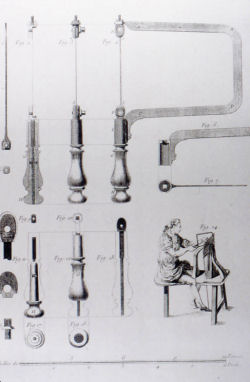
Once marked out, the timber needed to be cut to shape. Straightforward cutting to length used an appropriate saw, but if cutting curves, a bow saw was employed. This frame saw (which could vary in size) tensioned its blade by using a twisted cord and toggle stick. The blade is fixed so it can be turned to any angle in relation to the frame. Once used to cut veneers with a very fine saw blade they are now usually associated with cutting curved pieces. They may be made by a craftsman for their own use or factory bought.

Once the shapes had been roughly cut out the pieces were planed smooth.
Planes operate as shaping tools, fitting tools and finishing tools. The use of plane for shaping diminished over the period as sawn timber of a variety of thicknesses became available. For fitting purposes, the trying or jointing plane was most common as they finished the edges of boards to be butted together. The rebate plane was used for smaller work such as cutting rebates. These planes, usually with a wooden stock, were often made by the furniture craftsmen. Another example might be the 'Old woman's tooth', a term for a router plane that removes housing waste from grooved work or deepening flat sections in carving. These again may be home made.

Mechanised saws, and planing machines had been developed by simply trying to replicate the reciprocating human action and in 1776, the first machine was invented by Leonard Hatton. Bentham improved upon this patent, first with a reciprocating plane and then with one based on the rotary principle. Later models, all had horizontal cutter blocks in place of the vertical spindle. All subsequent planing machines were then based on the rotary knife principle.

The introduction of band-saws originated with an invention by William Newberry in 1808. However, it was not until the success of a Msr. Perin of Paris, who produced a band-saw blade that lasted reasonably well, that the machine was viable and operated satisfactorily. The fretsaw, jig, or scroll saw, developed from the simple marquetry cutter's saw during the nineteenth century, was one of the simplest and most useful tools for the cabinetmaker. Often treadle-operated with a single blade, it could cut out intricate shapes, and satisfy the demand for the most elaborate decoration.

Turning was also an important part of the furniture makers' repertoire and was often carried out by a specialist. Until the early seventeenth century, turnings were produced on dead-centre lathes, driven by treadle or wheel or on the pole lathe. For much of the century, knob and ring turning and bobbin turning were repeated but towards the end of the century, there were some contrivances introduced that allowed a twist or spiral to be put in on the lathe rather than by using hand-rasping to achieve the effect.
As changes in the economics of the industry occurred, developments in powered machinery began that had an impact on both preparing and assembling. In 1805, Brunel took out a patent for large circular saws particularly associated with veneer-cutting and in 1807 developed the saw further in association with block-making machinery. However, one of the most important developments was not on this scale at all. The small circular saw of up to seven inches diameter, often operated by a treadle, was one of the keys to the success of small-scale furniture makers. This saw enabled makers of cheap furniture to square up, mitre and rabbet cleanly, accurately, and quickly, allowing the frames of cheap carcase work to be simply rebated and nailed. This method of rebating, using a circular saw, was particularly useful for drawer-making which was traditionally a place for using dovetail joints. The advantage of this cheap method was that a dozen drawers could be made in the time it took to dovetail joint just one.

Construction and assembly
Fundamental changes in construction occurred during the seventeenth century with the use of veneers, dovetail jointing and improved drawer construction. However, distinctions between joinery and cabinet-making can be rather arbitrary as cabinet-makers used mortise and tenon joints for example, and joiners used dovetails, but the refinement was really in the change from working with solid wood, using joinery techniques, to cabinet-making using the skills of fine jointing, veneering and flush-carcase making.
As has been indicated, cabinet-making was based on the application of veneers onto a pre-formed carcase which was hidden beneath the surface. The basic principle of this kind of work is the construction of a rigid carcase, often using dovetail joints, to which a number of other items including doors, drawers and fall-flaps may be fitted. The revival of veneering in association with this method of working meant that less important timbers could be used for the carcase and the expensive exotic timbers could be used sparingly for surface decoration. Once the basic cabinet-making methods were established various developments and changes were made as tastes and demand required.
One process of construction that continued without question was the use of plies and laminates of wood for the construction of chair splats and fretted galleries. The use of plies in mid-eighteenth century work was merely a solution to a problem; it was not seen as a momentous technical advance. It was evidently common practice for larger plies to be used as well. Sheraton describes the construction of his Universal table by saying '...the panels are sometimes glued up in three thicknesses, the middle piece being laid with the grain across, and the other two lengthways of the panel to prevent it warping.' Developments that are more deliberate occurred in the work of Chapius in Belgium, and Samuel Gragg in the United States. Both men made chairs with bentwood components but the process was subordinate to the ruling taste in design terms. Tambour doors were introduced from France in the latter part of the century and were used as decorative falls or covers for night tables, pot cupboards and desks.
The mechanisation of the process of joint cutting that traditionally used saws and chisels originated with Bentham and his comprehensive patents of 1791 and 1793, but the methods were not commercially viable until the 1850s. Developments such as the leg moulding boxes used for holding legs while being moulded, fluted or grooved for inlay were pragmatic examples of solutions to practical problems. In this case, the piece to be worked was held in the box with a screw or wedges so that a scratch stock could mark out the work along the axis of the leg.

Decoration
Decoration includes veneering, carving and the use of mouldings and inlays. Veneering, which has a very long history, was the process that distinguished the cabinet maker from the joiner in the later seventeenth century and onward. The basic process of applying veneers to surfaces involves a few simple tools and the requisite materials. There are two traditional methods of hand laying veneers, by the hammer or by the caul. The hammer method was used for simple flat work with pliable and mild veneers. The process involved the warming of both the veneer and the base, followed by the spreading of glue to both surfaces. The veneer was then rubbed down onto the base and the hammer was applied to the surface, thus removing all the air to obtain a good adhesion. The caul method is based on applying heat and pressure to the veneer in relation to the shape, dimension and form of the base. In the eighteenth century, the cauls would be made of sandbags which were especially suitable for round or hollow work; otherwise, they would be especially constructed, often out of pinewood, to fit those pieces to be veneered. The pressure required to bond the two parts might be obtained by go-bars.
By the nineteenth century, these veneering practices which had endured since the seventeenth century were beginning to be inadequate for the larger volume of furniture being made during the nineteenth century. As with machine tools, large manufactories used steam power to heat the cauls which were largely made up from iron boxes with screws and clamps. Shops without steam power used a thick iron plate heated with gas jets in the same way. In contrast, the manual method which involved the prepared panels being put in a press, and then held down by planks and poles which abutted against the beams of the workshop, continued to be used.

As one of the most important decorative elements of furniture throughout many periods and in many locations, furniture carving has ranged from the most elementary scratch marks through to full-scale sculptural work. Carving methods varied widely (see below) so that only simple tools were required for basic jobs e.g. gouges and chisels, whilst more complicated work required a range of other chisel types, rasps, and punches. The specialist tools used included the carver's bench screw, designed to hold wood blocks secure with free access; the carver's clip which when used in pairs secured work on a bench; a wider range of carving chisels (over 1000 variations); a carver's cramp; a selection of chip carving knifes; a carver's mallet, a router plane for the flat recessed parts of work; a range of carvers' punches (with a variety of designs on their ends), and the riffler (a double-ended file used for smoothing curved parts).
The use of mouldings is generally decorative but they have a very early origin as most designs were based on prototypes established by classical architecture. Originally, they were cut into solid wood, but with the advent of panelled construction, they could also be applied. The application of decorative mouldings to carcase furniture, ranging from a simple cock bead to a drawer front, through to an elaborate built-up cornice, meant that techniques of producing mouldings changed in relation to prevailing styles. Mouldings were usually applied in two forms. In one case they were built up on a backing of inferior wood; alternatively they were produced as a composite of several simpler moulded shapes, thus offering a large variety of decorative possibilities, relatively simply. Particular developments included wave moulding where a wave-moulding machine was developed. It mechanically produced an undulating reeded band by a process akin to copying a template model. This particular moulding was often executed in ebony or ivory or stained sycamore. Moxon described its operation:

"as the rounds of the rack ride over the round edge of the flat iron, the rack and riglet will mount up the iron, and as the rounds of the waves on the underside of the rack slides off the iron on edge, the rack and riglet will sink and so in progression .... The riglet will on its upper side receive the form of several waves." (1703, pp. 106-7)
The hand worked moulding tools were initially made by the cabinet-maker himself but as the demand grew, specialist moulding-plane makers set up in business. The plane-maker was usually able to make any profile of cut to a customer's requirements, whilst the home-made scratch stock or standard irons continued to be used for the more simple mouldings. The standardisation of moulding planes occurred around 1770, but this did not mean a limiting of variety. Some American woodworking shops had as many as one hundred and forty-three varieties of moulding plane in their tool collection.
Nevertheless moulding mills were established during the 1840s in England particularly to take advantage of Muir's 1827 patent mechanism and the abundant supplies of Canadian yellow pine that were generally soft to work and free of knots.
Machines that allowed a cabinetmaker to produce the decoration for his own work included the spindle or toupie moulder. It was said that it was particularly useful for Gothic or medieval work ‘as more chamfering can be done by it in one hour than could be done by handwork in a day'.
The use of machines in the conversion of raw material and the construction of furniture during the nineteenth century is a story of both important changes and minor developments. The development of machines for preparing and shaping timber. (planers, mortisers, borers, dovetail-cutters and veneer cutters) was the most important change which affected all woodworking industries, including particularly shipbuilding and house building. Machines for processing and shaping parts (band-saws, fretsaws and lathes) were also being used in larger quantities as was the third category of machines, (embossers, moulders, and carving machines), that produced decoration.
The story of furniture making tools is an example of evolution, pragmatic development and eventually, a transition to mechanisation in response to changed demands.

OLD WOODWORKING PLANES

By Andrew Stephens
Since time began, man has made use of wood as an important raw material for many products, including houses, boats and furniture. To work wood, man needed tools, the earliest of which were made of flint, stone, wood, bronze and iron. The earliest extant tools are in museums and there are many which have survived from Ancient Egypt. In this country many tools have been unearthed which date back to the time when the Romans disseminated their new technology to conquered lands. The Romans were the first to manufacture planes from iron, although the material continued to be the basis of plane making throughout the medieval period, and was only gradually replaced by wood as the Middle Ages came to an end.
The most famous planes to survive from the Tudor period were brought up with the "Mary Rose" which sank in 1545. These planes were wooden, and are more continental than English in design. On show in the "Mary Rose" museum, they are in remarkable condition for their age, particularly considering their having been underwater for 450 years.
Until the late 17th and early 18th centuries nearly all woodworking tools were made by the user or the local blacksmith; the craftsman crafting the wooden parts and the blacksmith the blade. Around this time the first recognised plane and tool makers started to appear. The two earliest recorded British plane makers were Frances Purdew and Thomas Grandford, who both worked in London.
There were three generations of Thomas Granfords, and it is thought that the first worked from 1654 to 1685. Recent research has found that many planes once thought to have been made by Granford were actually Purdew's work. (Photo 1.) In fact, we only have one plane which can be identified for certain as having been made by Granford.


Image 2. Shown left is an early 18th C. moulding plane by Robert Wooding (1706-1728). Note the flat chamfers round the top and the early shape wedge. Little is known about Purdew, other than that he lived in London and was a contemporary of Granford. Several moulding planes are known by Purdew, four having been sold recently at auction. Other famous plane makers from that period include Robert Wooding, an apprentice of Granford who worked from 1706 to 1728. Moulding planes by Wooding do come up for sale today on a fairly regular basis and command large prices. John Davenport and Robert Hemmings are two manufacturers known to have been working in the early 1700s, although little is known about either of them

Image 3. Shown left is a superb example of a very early plane (possibly even 17th C.) Again the wide flat chamfers & early long shaped wedge. The plane has been shortened at both ends, as chamfers are not as wide there.
Early named moulding planes are scarce, and there is an intriguing reason for this. The earlier versions were in general much longer than the later moulding planes-usually 10 to 12 inches compared with the standard 9 ½ inches of later planes. If an early 19th century craftsman bought some "modern" moulding planes to add to his collection of earlier models, he would discover that the earlier, longer planes stuck out further on the shelf. The answer to this problem was easy-he just shortened the older ones to match! Unfortunately for us today, it means that many early planes are without a maker's name; the front, where the maker's stamp would have been, has been removed. The moulder in picture 3 dates back to the early 18th century and has been shortened both at the front and back, but displays many period features , including the large wedge and flat chamfers. You can see the similarities with the Wooding moulder in photo 2.


Image 4. A rare beech bridal plough plane with ebony arms by A. Mathieson & Son, Glasgow & Edinburgh. One of the best quality plough planes Mathieson made; they only commercially made one better.
As better tool-steel became more readily available and the process of producing it cheaper and easier, tool manufacturers started to spring up in all the major cities, including London, Sheffield and Birmingham. As the population became more affluent and the demand for furniture ever greater, the demand for tools increased considerably. By the mid-19th century the tool making industry was huge, with literally thousands of manufacturers all over Britain. Some of the biggest and perhaps most well-known today were Alex Mathieson and Sons of Glasgow and Edinburgh, who by 1898 offered the largest range of tools in the world (Photos 4 and 5), William Marples of Sheffield, Robert Sorby of Sheffield and Mosely and Sons of London.


Image 5. A very rare 25 1/2" long dovetail steel jointing plane by Mathieson. It has a gunmetal cap and a very good nicely gained rosewood infill. Pretty heavy but a joy to use. Long wood filled jointing planes such as this are few and far between and command high prices.
It wasn't until the mid-19th century that steel started to be used as the basic material for plane making. Stewart Spiers is widely recognised to have been the first manufacturer of steel planes in Britain, starting his business in 1840. (Photos 6 and 7.) Spiers' original ideas were copied by Mathieson and improved upon by Thomas Norris. It was at this time that Britain produced some of the finest quality tools ever made.


Some of the planes made by Spiers and Norris have, in my opinion, have never been surpassed.
Image 6. Rare early "improved pattern" dovetail Stewart Spiers (Ayr) mitre plane. Note screwed sides and early long shape of lever cap. Nicely rosewood fill and with original snecked iron.


 Image 7. One of the rarest Spiers planes ever made around 1930s to try to compete with Stanley planes.
Basically rubbish compared with most Spiers planes but its rarity would command four figures at auction today.


Image 8. Good early Norris of London 13 1/2" long dovetail steel plane. One of the best planes ever made.
Only the earliest Norris planes had rosewood infill like this—most found today have beech infills.


Image 9. Early Norris smoothing plane. Dovetailed coffin shape No A2. A 1913 patent blade adjuster and rosewood infill.
  By the early 20th century Stanley of America had started to take over the metal plane market all over the world. In Britain, however, it was the late 1930s before they displaced Spiers and Norris, and only then because of the low price of their planes. Although Britain produced the best quality planes, Stanley produced the biggest range, priding themselves that they could produce a plane for virtually every job. The range of planes offered by Stanley from around 1900 to 1950 was the biggest ever and is unlikely ever to be surpassed.

 Image 10. One of the more rare Stanley planes. A No 9. Cabinet maker's block or mitre plane.
Early 1900s made by Stanley Rule & Level Co. USA.
Due to the shape of the back not many survive damage because of being dropped.

Image 11. A more unusual Stanley (USA) o 95 edge trimming plane. Initially used for truing up man-made boards before veneering.
Today, sadly, quality new tools are few and far between, with companies such as Stanley and Record producing a fraction of the range they once did, and those they do produce being of dubious quality. However, companies such as Lie Nielson are now reproducing some of the planes that Stanley once made, which are just as good. And there is one company in Britain worth mentioning who are making copies of early Norris planes of outstanding quality in gunmetal and steel. Karl Holtey's planes are the best modern planes money can buy. Some people believe that they are actually better than the originals and I wouldn't argue about that, though at prices ranging from £1000 to £2,500, they are not within many craftsmens' reach. (Photo 12.)

Image 12. New quality adjustable block plane by Karl Holtey with steel sole dovetailed to gunmetal sides and very nice rosewood infill and thick parallel blade. Just simply the best modern plane money can buy.
Many people today laugh at me when I say I use nearly all old tools in my work. "What do you use those old things for when you can buy new ones?". Why indeed! In common with many craftsmen I speak to, I didn't always use old tools. I remember when I started my first real job after leaving school, at a large antique restoring business in Hampshire. I arrived with two boxes of shiny new tools, many having been bought by various well-intentioned relatives. I unpacked these tools and saw some of the established, older restorers glancing over their shoulders and sniggering, and I wondered why. It didn't take me long to find out. I soon discarded my blue plastic-handled Stanley chisels in favour of much older models.
Many of the older planes are as useable today as they were when they were made, and in many cases are cheaper to purchase than new ones. Moulding planes are a good example; you can buy a good cabinet moulding plane cheaper than one router cutter and you don't have to remove all the burn marks afterwards! I remember having a very heated argument with a colleague a few years back about using moulding on a chest of drawers, which needed new feet and moulds. By the time he had found a suitable router cutter and set up the router ready to use, I had made all the moulding and had one section glued on. We never had that argument again! It is sometimes hard to find moulding planes of the right profile to cut moulds found on furniture, as most moulding planes were made for house architecture. But if you can find suitable planes, once they are set up and sharpened it is so much easier than using a router.
As for bench planes, if you are lucky enough to own or to have used a Spiers, Norris, or similar un-named example you'll know what a joy that is. No chatter even on the most awkward of grains, the extra weight which is so beneficial, and most importantly, the comfort of use. The thick parallel iron found on these planes in itself weighs more than a complete modern plane. I usually find anyone who takes the plunge and purchases one of these old wood filled planes, whether a named example or not, never looks back.
Unfortunately for us craftsmen, many of the best tools ever made are sitting on collectors' shelves gathering dust. It's sad really, but I suppose looking on the bright side they are being preserved for future generations. However, in my opinion these planes were made to be used, and should still be used and enjoyed by the craftsmen of today. If you don't use old tools, all I can say is - you don't know what you're missing!